
Clay County Court Records After Arrest
After a Clay County arrest, the jail record and the court record answer different questions. The jail side shows custody, booking, and release status. The court side shows the prosecutor's filed charges, hearing dates, bond orders, warrants issued by a judge, amended charges, pleas, dismissals, sentencing, and final disposition. Clay County criminal cases are handled in district court through the 21st Judicial District, which covers Clay and Riley counties. The Clay County District Court page links the public to district court records, and Kansas provides a statewide search portal for many filed cases.
The pathway is simple in outline but easy to confuse in practice: arrest, booking, first appearance, prosecutor review, filed charge, and court action. Clay County Attorney Brenda Jordan's office prosecutes state-law and county-resolution violations, including felony crimes and juvenile crimes countywide, plus misdemeanor and traffic violations outside city limits. A booking allegation can change when the county attorney files a complaint or information. For current jail custody and booking facts, use Clay County jail inmate records. For booking photos, use the Clay County mugshot page rather than treating the court docket as a photo source.
The official Clay County District Court page is the local court source for the 21st Judicial District and clerk contact. The page shown in the county screenshot links readers from Clay County into the state case-record system.
View the Clay County District Court source page before using the court contact details below.
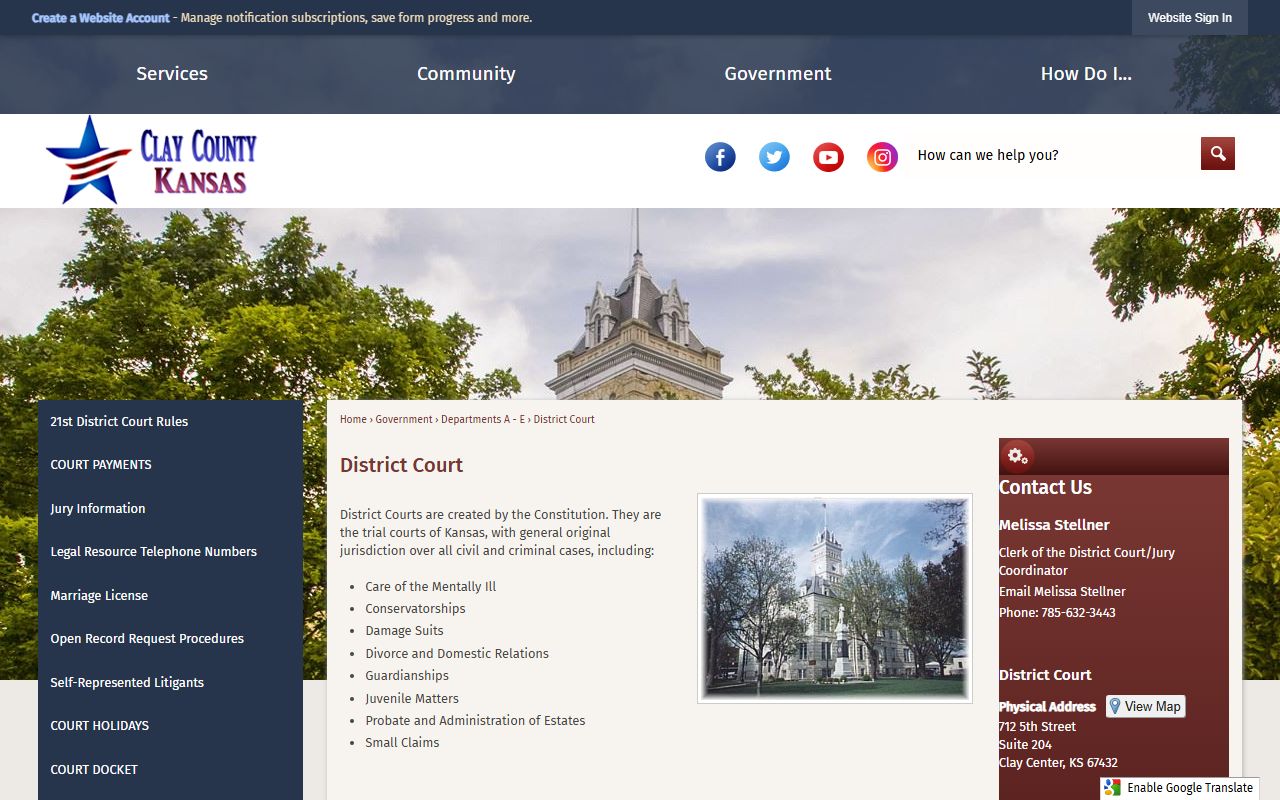
That local court page matters because it separates court-record questions from jail-custody questions handled by the sheriff.
Find Clay County Court Records
Kansas Case Search is the main online starting point for Clay County court records after a jail arrest once a case has been filed and indexed. It is not the Clay County jail roster, and it should not be used to decide whether a person is still in custody. Instead, it helps locate the court case that follows the arrest. Search by case number if it is known, or by the defendant's name when the number is not known. If a portal search fails, the clerk may still be able to explain public terminal access, older records, or request steps.
- Open Kansas District Court Case Search and choose a search path that matches the details already known.
- Search by defendant or party name, case number, business name, citation, or other available criteria.
- Open the matching Clay County criminal case and compare the filing date with the arrest or booking date.
- Read the charge list, bond entries, warrant events, hearings, and disposition fields as separate case events.
Use the Clay County District Court clerk when the search portal blocks access, lacks an older file, or does not show enough detail. The clerk is Melissa Stellner, Clerk of the District Court and Jury Coordinator. The office is at 712 5th Street, Suite 204, Clay Center, KS 67432, phone 785-632-3443, and public hours are Monday through Friday, 8 a.m. to 5 p.m. Court records are separate from statewide criminal-history checks through Kansas.gov, and KASPER is a corrections locator, not a full criminal-history report.
| Search Field | Use | Clay County Note |
|---|---|---|
| Case number | Direct case lookup | Best when the clerk, citation, or court notice already gave the number. |
| Party name | Defendant or party search | Use full legal name, and check spelling variations after arrest. |
| Business name | Entity party search | Useful for non-person parties, not most jail-arrest cases. |
| Citation or other criteria | Filtered search | May help with traffic or municipal-linked matters when available. |
The Kansas Case Search portal screenshot is a matching source image for the court-record lookup step.
Open the Kansas Case Search source page when checking whether filed charges have appeared.
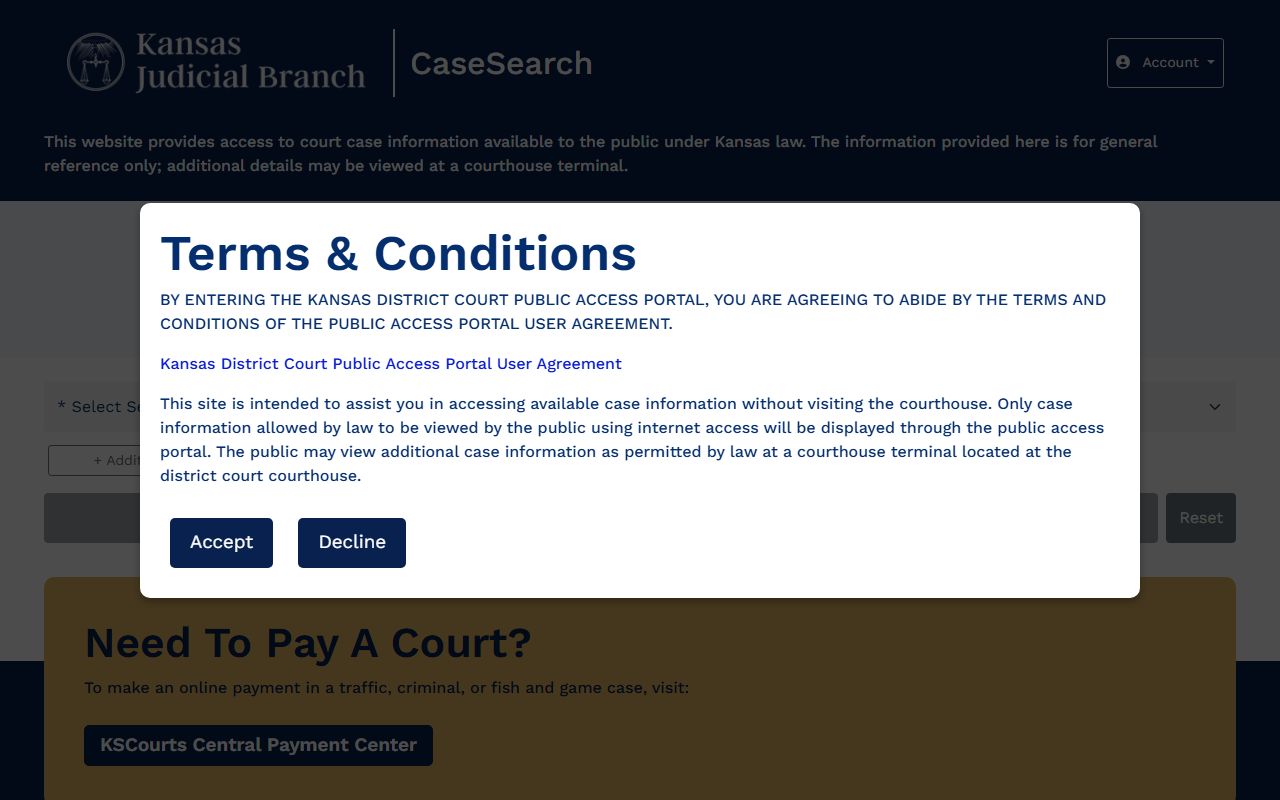
Search results should be read as court records, not as proof of current jail custody or release.
Clay County Arrest Charge Documents
Charges enter the court record through a charging document. In Clay County, the county attorney reviews reports from the sheriff, city police, or another arresting agency before the filed case becomes the controlling court record. The first jail booking charge can be only an intake label. The filed charge may match it, narrow it, add counts, drop counts, or use a different charge level after review. That is why court records after a jail arrest often need both a case search and a call to the jail or clerk.
| Document | Who Usually Files It | What It Does |
|---|---|---|
| Complaint | Prosecutor, often based on law-enforcement reports | Starts many criminal cases and lists alleged offenses for court action. |
| Information | County attorney | States formal charges after prosecutor review and may replace or refine early allegations. |
| Indictment | Grand jury | Charges an offense through a grand-jury process, used less often than complaints or informations. |
Clay County Attorney Brenda Jordan's office is in the Clay County Courthouse at 712 Fifth St., Suite 202, Clay Center, KS 67432. The phone number is 785-632-3226, and listed hours are Monday through Friday, 8 a.m. to noon and 1 p.m. to 5 p.m. The attorney's office prosecutes felony crimes and juvenile crimes anywhere in Clay County, as well as misdemeanor and traffic matters outside city limits.
View the Clay County Attorney source page for the local prosecutor role and contact block.
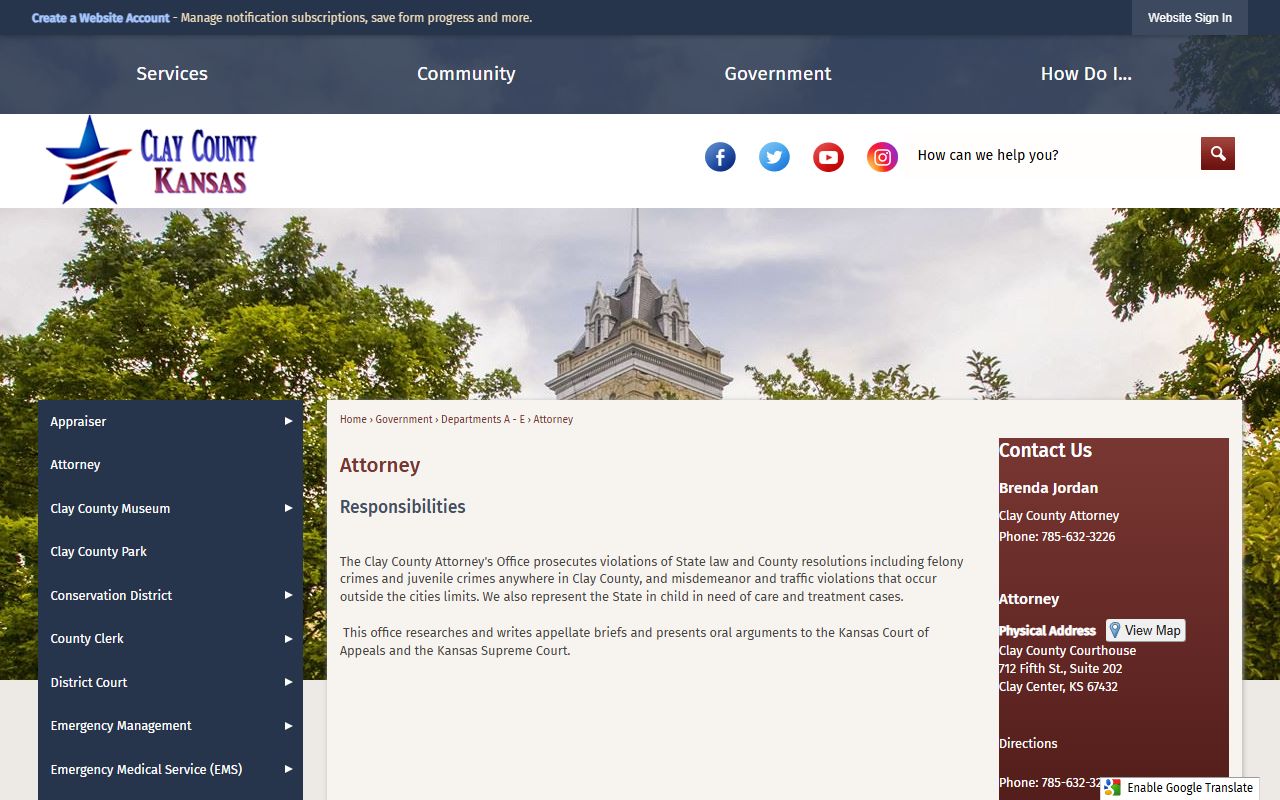
The prosecutor source helps explain why a jail booking charge may not be the final charge shown in court records.
Clay County Charge Status Records
Charge status is the current court position of a count. A Clay County case may start with one set of allegations and end with a different list after amendment, plea, trial, or dismissal. The status field is important because a person can be arrested and charged without being convicted. It also explains why a jail bond entry, a case event, and a final judgment may not use the same words.
| Status | What It Means | How to Read It |
|---|---|---|
| Pending | The charge is still active. | Look for the next hearing date, bond order, or warrant entry. |
| Amended or reduced | The prosecutor or court changed the filed charge. | Compare the new count with the original booking allegation. |
| Dismissed | The charge ended without conviction on that count. | Check whether other counts remain pending or were resolved. |
| Disposition entered | The court recorded an outcome. | Read whether it reflects plea, trial, sentence, diversion, or dismissal. |
When a case is not clear online, the district court clerk is the right contact for court-file questions. The sheriff is the right contact for current custody, transport, release, and jail records. The county attorney's office is not a substitute for legal advice and may not provide case strategy or private interpretation of evidence.
Note: A Clay County arrest record can exist even when the final court record shows dismissal or amendment.
Bond After Clay County Arrest
Bond questions can sit in more than one place. The Clay County Sheriff's Office can confirm custody and local release instructions by phone at 785-632-5601. The Clay County District Court can answer court-set bond and hearing questions at 785-632-3443. The court page says Visa, MasterCard, and Discover are accepted for court payments, but that fact should not be treated as a jail bond rule. Bond instructions must be confirmed with the office that controls the payment or release step.
| Bond Type | Meaning | Clay County Checkpoint |
|---|---|---|
| Cash bond | Money is posted to meet a court-set release amount. | Confirm with jail or court before paying. |
| Surety bond | A licensed bonding agent posts the bond obligation. | Ask whether the court order allows surety. |
| PR bond | Release on a promise to appear, without posting the full amount. | Look for the judge's order and release conditions. |
| No-bond hold | Release is not allowed under the current hold or warrant. | Ask whether another agency or court controls the hold. |
A detainer is a request or hold from another agency. It can keep a person in custody even if the Clay County bond is posted. Holds may involve another county, a city case, KDOC, federal authorities, or immigration custody. That is why a court record after an arrest must be matched with the jail's current custody answer before assuming a person can be released.
Clay County Warrants and Arrest
No official Clay County active-warrant search was found on the county site. The sheriff page links to Kansas Most Wanted, but that is not the same as a county warrant list. For Clay County warrant questions, call the sheriff at 785-632-5601, search Kansas Case Search for public case events, or contact Clay County District Court for court-file warrant questions. Municipal court or city police may be the better channel if the warrant comes from a city case.
- Arrest warrant
- A court order authorizing arrest based on probable cause or a filed case.
- Bench warrant
- A judge-issued warrant, often tied to failure to appear or failure to comply.
- Search warrant
- An order authorizing a search, not the same as an arrest warrant.
- Hold warrant
- A warrant or hold from another county, state, or agency.
Do not rely on third-party warrant aggregators for Clay County court records after a jail arrest. Direct court and sheriff channels are more likely to distinguish active warrants, old entries, recalled warrants, and holds that do not appear in a public search.
Clay County Charges vs Convictions
A charge is an accusation in a court record. A conviction is a court outcome after a plea, verdict, or other final finding. Kansas public access rules may allow the public to see many case events, but a public charge should not be read as proof that the person was convicted. This distinction is central to court records after a jail arrest, especially when the arrest was recent or the case is still pending.
| Point | Charge | Conviction |
|---|---|---|
| Stage | Filed accusation after arrest or prosecutor review. | Final finding through plea, verdict, or judgment. |
| Proof level | Based on probable cause and filed allegations. | Requires court resolution under criminal-proof standards. |
| Record meaning | Shows what the state alleged. | Shows an outcome on the charge. |
| Best source | Kansas Case Search, clerk, or charging document. | Final docket entry, judgment, or clerk record. |
Clay County Sealed Records
Kansas law gives an expungement process for eligible convictions, arrest records, and diversions under K.S.A. 21-6614. Expungement is not the same as a casual deletion request. It depends on the case type, outcome, waiting period, and court order. A dismissed charge may still need formal court action before public search tools, agency files, or background-check sources stop showing related records.
| Issue | Sealed | Expunged |
|---|---|---|
| Public view | Public access is limited by court order or rule. | Eligible records are handled under the Kansas expungement statute. |
| Agency access | Some law-enforcement or court access may remain. | Access may remain for listed legal purposes. |
| How it happens | By court rule, order, or restricted-record status. | By petition and court order under Kansas law. |
| What to verify | Which record is sealed and from whom. | Whether jail, court, and state records all need updates. |
Kansas open-records law also includes exemptions. K.S.A. 45-216 states the open-records policy, K.S.A. 45-218 covers inspection and response rules, and K.S.A. 45-221 lists records that are not required to be disclosed.
Restricted Court Records After Arrest
Some Clay County court records after an arrest may be limited, delayed, or unavailable through a public portal. Juvenile matters, sealed files, restricted case types, active investigative materials, and certain records covered by Kansas exemptions may require clerk review rather than online access. The Kansas Attorney General's KORA guidance also distinguishes open jail rosters and police blotters from records that agencies may close under statutory exemptions.
Important: Public court and jail lookups are not consumer reports and should not be used for credit, employment, insurance, housing, or tenant screening decisions.
For a complete statewide criminal-history path, Kansas points users to Kansas criminal history record search. KASPER can help after a person enters KDOC-related custody or supervision, but its own disclaimer says it is not complete criminal history. Federal custody is checked through the BOP inmate locator, and immigration custody may require ICE Online Detainee Locator System. These tools serve different custody systems, so a Clay County arrest should be checked in the system that now controls the person or record.